The Architect Behind Manhattan Crypto Capital

Founder Spotlight, 2026
"We are not chasing the cycle. We are building the cycle."
It is a line Zaid Khan has used so often inside Manhattan Crypto Capital that it now reads as operating philosophy more than rhetoric. Most digital asset firms were designed for the upside. Khan designed his for both halves of the cycle, which is part of why the people who allocate to him tend to stay.
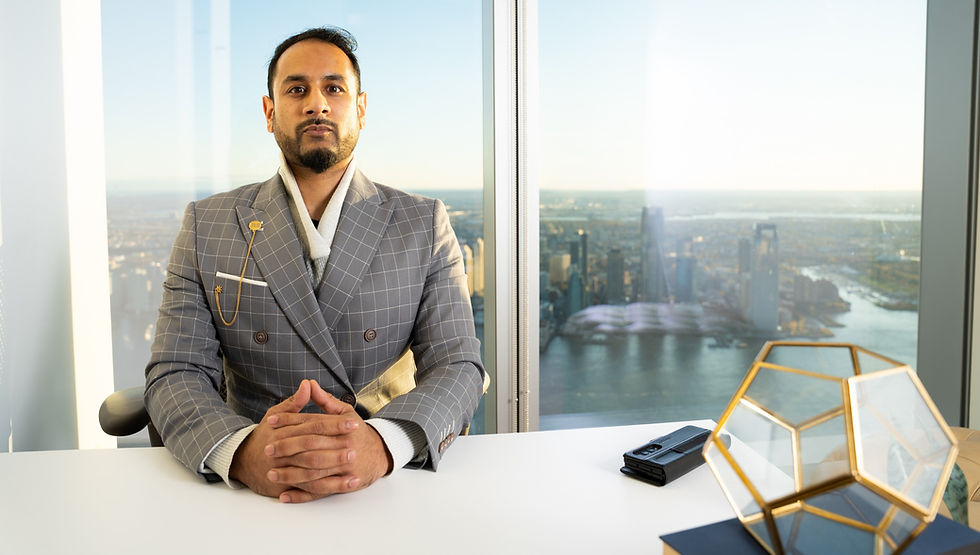
He runs Manhattan Crypto Capital, the Reg D 506(c) hedge fund registered with the SEC under CIK 0001924586, out of One World Trade Center. He also runs Manhattan Global Partners, the family office platform that sits above it. Underneath all of that, his personal vehicle, Zaid Khan Investments LLC, is itself a limited partner in MCC. So when he talks about being aligned with his investors, it is not a marketing line. His own balance sheet is in the same waterfall.
A Builder Before a Trader
Khan's first business was not crypto. It was construction.
At eighteen he started a company and scaled it into a multimillion dollar operation. By his mid twenties he was the youngest union owner in New York City's Local 638. By twenty eight he had sold it. The lessons he took out of that period were the kind finance majors typically have to learn the hard way later: how cash flow actually behaves under stress, what payroll cycles do to discipline, and what a single bad decision costs when you cannot offload the consequences onto a counterparty.
He bought his first Bitcoin in 2013, when most of his peers were treating the asset as a hobby. Khan was already building strategies around it. Arbitrage trades, mining economics, and early experiments with machine learning driven advisory logic. Over the next decade his crypto book returned 987 percent. The number, he says, matters less to him than the playbook that came with it. The zone based deployment rules, the tiered margin framework, the cycle targets per ticker. All of it grew out of those years, and all of it is now codified in the master plan that governs MCC today.
Putting the Institution Together
In 2019 Khan acquired a UK fintech. In 2020 he merged with a quant AI firm in Dubai. Those moves gave him the engineering bench and the cross border infrastructure he needed to stand up something regulated.
Manhattan Crypto Capital is what came next. It targets a $110 million exempt offering through its Reg D 506(c) and Reg S filings, and it sits inside Manhattan Global Partners, the platform that connects it to sovereign wealth funds, family offices, and institutional allocators in New York, Dubai, and across the MENA region.
The fund operates on three engines. Growth is where the crypto and AI tech equity exposure lives. Stability is anchored by gold, metals, and broad market positions. Income runs through a thirty instrument private credit book. Each engine has its own
deployment rules. Every mandate ticker has its own buy zones, labeled BZ1 through BZ3, and its own T1 exit target. Margin exposure is tiered into four bands named after traffic light colors, and the moment the portfolio crosses into the Orange band (between 45 and 55 percent), no new margin is deployed. That rule has never been overridden.
It is the kind of structure you build when you have lost money before and remember exactly how it happened.
A Quieter Kind of Conviction
People who have worked alongside Khan describe a particular rhythm. He runs his Sunday reviews on time. He locks his master plan into versioned documents and treats deviations as exceptions that need to be justified in writing. He places his orders as GTC limits and lets them sit. He does not override the system during a green candle, and he does not override it during a red one either.
A few of his lines have become shorthand inside the firm.
"We do not chase markets. We design systems that compound through them."
"Innovate before you get innovated."
"Our benchmark is not another hedge fund. It is the compounding our investors demand."
None of these were written for a pitch deck. They are operating instructions. The BZ3 sizing rule, the T1 trigger logic, the equity ratio thresholds that decide what gets cut and what gets held, all of it traces back to the same internal grammar.

The Principle Underneath
Ask Khan what he is actually doing all of this for and the answer has very little to do with money.
"Inspire as many lives as possible before I expire."
That line shows up in his investor letters, his mentorship conversations, his interfaith work, and the way he structures his philanthropy. It is also why he tends to describe MCC as an institution rather than a fund. Funds end. Institutions are designed to outlive the people who built them.
Investors who have allocated to him tend to describe the experience in similar terms. They are not buying a product. They are stepping into a longer compounding arc that started on a New York job site at eighteen and now spans three continents.
What the Industry Tends to Miss
The crypto industry produces a lot of personalities. It produces fewer operators. Khan belongs to the second category. He is not the loudest voice on the timeline, and he is not the most aggressive trader on the leaderboard. He is the one who is still likely to be running the same system five cycles from now.
In an industry that mostly remembers its winners by their loudest year, Khan looks built to be remembered for consistency. That is the rarer feat, and it is the one he is actually after.


Comments